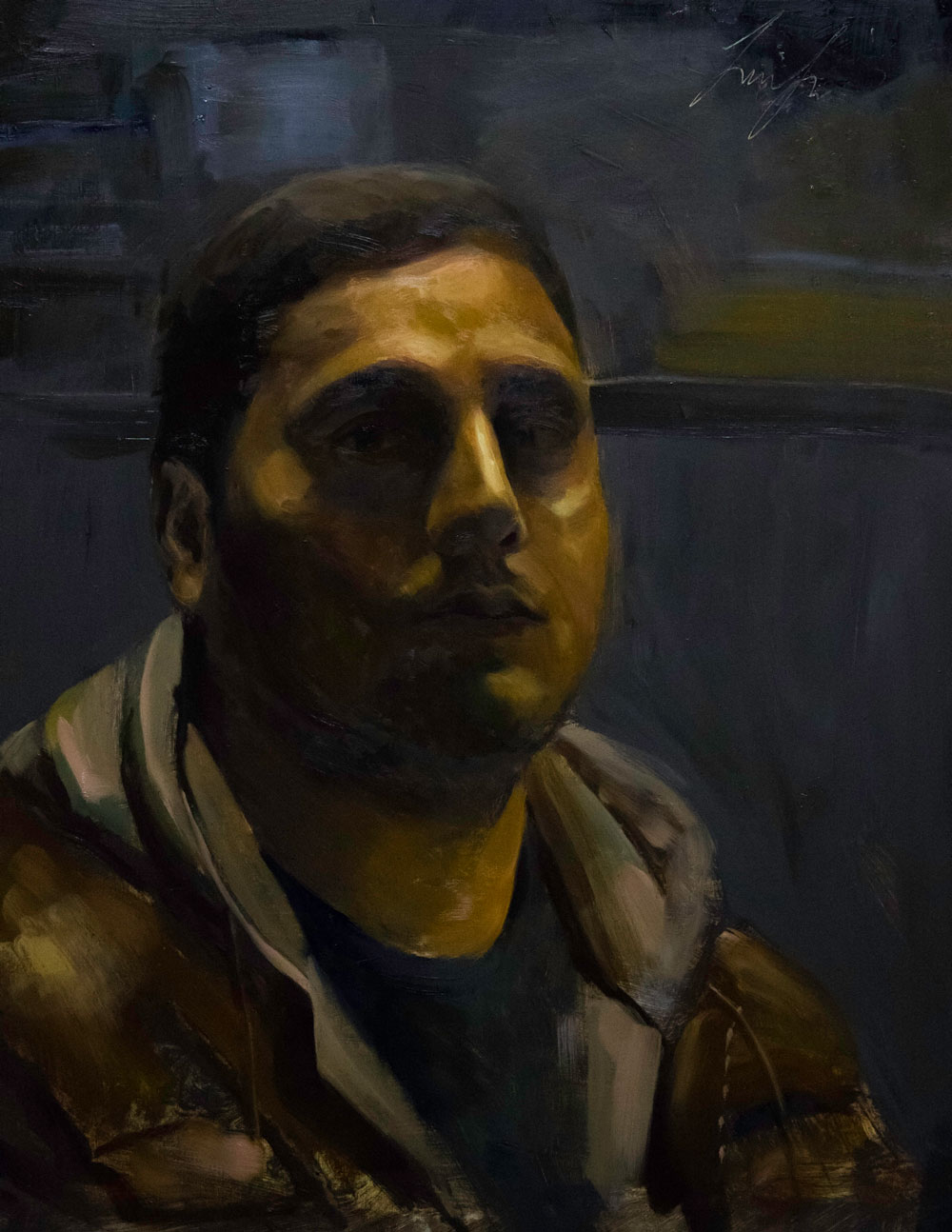
TL;DR — Quick Summary
A reflection on slowing down, observing the figure, and resisting the urge to explain too much through paint.
I have been thinking more about how much of painting happens before the brush touches the surface.
For a long time, I felt an urge to start quickly. I wanted to find the likeness, put down the color, and see the painting begin to exist.
Lately, I have been trying to slow that part down.
I spend more time looking.
Not searching for details, but trying to understand what gives the subject its presence.
The tilt of a head.
The weight carried through a shoulder.
Where an edge disappears into shadow.
How one shape leans into another.
These small relationships often say more than the details I used to chase.
Looking before deciding
When I look at a figure, my first instinct is often to name what I see.
An eye. A nose. A hand. A shirt.
Painting becomes more interesting when I stop naming things and begin looking at them as shapes.
A cheek becomes a plane turning away from the light.
A dark shirt becomes one large mass interrupted by smaller shifts in temperature.
The space beside the figure becomes as important as the figure itself.
I find myself asking fewer questions about what something is and more about how it sits in relation to everything around it.
That shift has helped me simplify.
It has also made me more aware of how easily a painting becomes overworked.
I do not need to explain everything I see.
Some passages need structure.
Others need to remain open.
The difficult part is deciding which is which.
The figure does not need to perform
I am drawn to figures when nothing obvious is happening.
Someone sitting quietly.
A person looking away.
A posture that suggests fatigue, thought, distance, or simply waiting.
These moments interest me because they leave room for observation.
There is no large gesture telling the viewer what to feel.
The figure is simply there.
I think this is part of what I keep returning to in figurative painting. The human body carries emotion even when it is still.
A lowered head or a slightly tense shoulder often communicates enough.
Adding more sometimes weakens it.
Leaving parts unresolved
I used to think finishing a painting meant resolving every part of it.
Now I am more interested in deciding where the painting needs clarity and where it should remain loose.
A carefully observed face might sit beside a shoulder described with only a few strokes.
A background might disappear almost completely.
An edge might exist in one place and dissolve a few inches later.
These decisions affect where the eye rests.
They also give the painting room to breathe.
I admire painters who seem confident enough to leave things alone.
Velázquez could place a few marks in exactly the right relationship and let the viewer complete the rest.
Antonio López García seems to arrive at a different kind of truth through sustained observation and patience.
Andrew Wyeth often leaves a quiet space around a subject that feels as important as the subject itself.
I think about these approaches often, even though my own way of painting is still developing.
A slower kind of attention
Painting has started to feel less like an attempt to capture something and more like an exercise in staying with it.
Looking longer.
Making fewer assumptions.
Waiting before correcting something.
Allowing uncertainty to remain for a while.
This is difficult because painting constantly presents decisions.
Every mark changes what came before it.
Sometimes the best decision is another mark.
Sometimes it is to stop.
I am still learning the difference.
For now, I want to keep returning to the same basic practice:
Look slowly.
Find the larger relationships.
Say only what needs to be said.
Leave the rest alone.